
Executive Overview
Despite these strong financial results, Wall Street remains divided on the company’s ambitious expansion plans. Analysts at Bernstein have raised significant technical flags regarding SpaceX’s timeline for deploying a direct-to-cellular mobile service by late 2027, citing fundamental hardware constraints in standard consumer smartphones. Conversely, analysts at Deutsche Bank present an extremely bullish long-term thesis, projecting that SpaceX’s emerging "Neocloud" AI infrastructure and satellite enterprise solutions could propel the company to an annualized revenue run rate of $100 billion by the end of 2026.
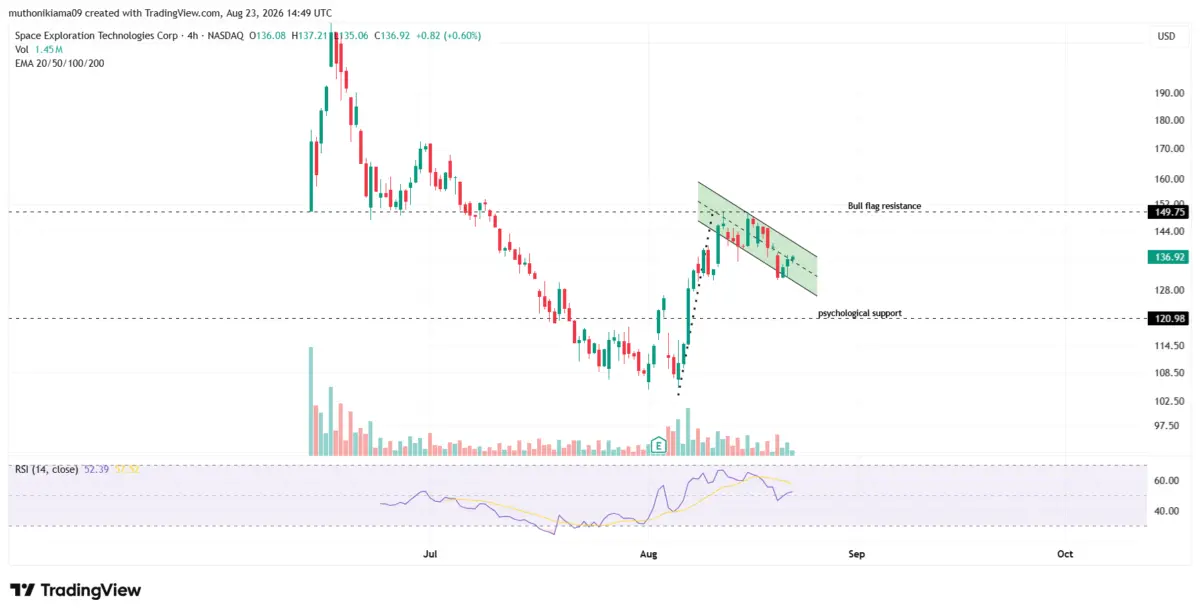
As the equity market navigates the post-lockup absorption of 319 million recently unlocked shares, SPCX stock displays a constructive technical setup. Trading just above its key $135 baseline support with a four-hour bull flag pattern in play, the stock is testing technical resistance at $149, with Wall Street price targets reaching as high as $248.
Detailed Chronology
  July 23, 2026           August 7, 2026          August 20, 2026         Late August 2026
       |                       |                       |                       |
       v                       v                       v                       v
Q2 2026 Earnings Released   Intraday Low Recorded   Share Lockup Unlocks    Technical Bull Flag
Revenues hit $7.8B (+92%)  Stock touches $120 baseline  319M shares eligible   Pattern emerges; tests
Starlink generates $4.3B    before institutional buy-in   for secondary sale     resistance at $149
July 23, 2026: Q2 Earnings Catalyst
SpaceX released its Q2 2026 earnings report, beating consensus expectations and disclosing $7.8 billion in quarterly top-line revenue. Management reiterated its commitment to launching a commercial direct-to-device (D2D) mobile telecom service by the end of 2027. The news triggered an immediate multi-week buying wave, pushing the stock up 18% from its pre-earnings baseline.
August 7, 2026: Volatility Retest
Following initial earnings enthusiasm, macroeconomic headwinds and profit-taking pulled SPCX down to an intraday low of $120. Institutional buyers stepped in at this valuation floor, initiating a sharp V-shaped recovery that established a higher support zone around the $135 level.
August 20, 2026: Lockup Expiration and Supply Absorption
A major structural event occurred as 319 million insider and early-investor shares became eligible for secondary market sale for the first time. Despite market concerns that this influx of floating shares would severely dilute trading value, order flow remained balanced, demonstrating strong market demand beneath the market price.
Late August 2026: Technical Flag Formation
Following the lockup expiration, SPCX settled into a tight consolidation pattern on the four-hour time frame. The stock crossed above its moving average midline to trade around $136, establishing a technical bull flag pattern heading toward the August 28 options expiry and resistance retest at $149.
Supporting Context & Metrics
Financial Performance Breakdown
SpaceX’s transition from a pure-play launch provider to a vertically integrated satellite communications and cloud-compute power house is reflected in its segment revenue distribution.
| Segment / Metric | Q2 2026 Value | Percentage / Yo-Yo Impact | Key Operational Drivers |
|---|---|---|---|
| Total Revenue | $7.8 Billion | +92% YoY Growth | Starlink expansion, launch frequency, AI compute |
| Starlink Broadband | $4.3 Billion | ~55.1% of Total Q2 Rev | Enterprise terminals, maritime/aviation contracts |
| Launch Services & Other | $3.5 Billion | ~44.9% of Total Q2 Rev | Commercial payload deployment, NASA contracts |
| Projected 2026 Run Rate | $100 Billion | Deutsche Bank Estimate | Scaled Neocloud AI deployment & Starlink v3 |
Q2 2026 Revenue Distribution ($7.8B Total)
===========================================
[#######################] Starlink Broadband ($4.3B / 55%)
[=====================] Launch Services, Neocloud & Other ($3.5B / 45%)
The $100 Billion Run-Rate Trajectory
Deutsche Bank analyst Edison Yu projects that SpaceX is positioned to reach an annualized revenue run rate of $100 billion by the close of fiscal year 2026. Independent market analyst Shay Boloor provided additional perspective on this figure, breaking down how non-traditional aerospace operations will drive the majority of this growth:
- Neocloud (AI Infrastructure): $48 Billion projected contribution. Orbital and terrestrial high-density AI compute nodes tied directly to Starlink’s optical laser mesh network.
- Starlink Broadband: $13 Billion projected contribution. Continued global expansion across consumer, commercial, and government sectors.
- Core Launch Operations: $7 Billion projected contribution. Heavy-lift launch services utilizing the Starship fleet.
- Next-Gen Satellite Enterprise Services: Balance of remaining run-rate capital.
This financial model highlights a major narrative shift: SpaceX is no longer being valued solely as a space launch operator, but rather as an emerging high-margin artificial intelligence and distributed data infrastructure enterprise.

Technical Chart Analysis & Trading Dynamics
SPCX Four-Hour Price Chart (Consolidation & Flag Setup)
-----------------------------------------------------------------
$149  |------------------------------------- [Breakout Target / Resistance]
$140  |             /       /
$136  |------------/-------/------------- [Current Trading Level]
$135  |===========/=======/============== [Pivot Point / Baseline Support]
$120  |____________________________________ [August 7 Swing Low Support]
-----------------------------------------------------------------
      | RSI = 52 (Neutral / Bullish Momentum)
Technical indicators on the four-hour chart suggest that SPCX is forming a classic bull flag continuation pattern:
- Price Action: The stock experienced a steep pole formation following Q2 earnings, rising from $105 to $136+. It is currently consolidating in a narrow downward channel above critical support.
- Key Pivots:
- Primary Resistance: $149. A sustained four-hour candle close above $149 validates the bull flag breakout, clearing a path toward the $165–$180 zone.
- Immediate Support: $135. Aligned near the initial public reference/IPO price level.
- Secondary Support: $120. Represents the August 7 low; a breakdown below $135 could trigger stop-loss selling toward this level as short-term traders lock in gains.
- Momentum Oscillators: The Relative Strength Index (RSI) sits at 52. This neutral-to-bullish reading indicates ample headroom before reaching overbought conditions (70+), allowing space for an upward move toward the $149 resistance level.
Official Statements & Analyst Commentary
Bernstein Flags Physics and Telecom Hardware Limits
While maintaining an Outperform-equivalent thesis and a $248 price target for SPCX based on long-term AI infrastructure and space launch dominance, Bernstein senior analyst Douglas Harned released a cautious assessment regarding the company’s direct-to-cell phone ambitions.
SpaceX management has stated its intention to provide commercial mobile coverage directly to unmodified consumer devices by late 2027. However, Harned pointed out structural engineering bottlenecks inherent to satellite-to-cellular link budgets:
“SPCX will likely need to continue exploring additional approaches to provide a wireless service capable of competing with incumbent operators,” stated Harned in a note to institutional clients.
Harned emphasized that connecting a handheld cellular device to a Low Earth Orbit (LEO) satellite constellation traveling at 17,000 miles per hour requires significant radio frequency (RF) output power from the handset. Standard smartphone batteries and internal thermal management systems are not designed for sustained direct-to-orbit uplink power requirements. Without custom hardware modifications from handset manufacturers, users attempting to utilize high-bandwidth satellite cellular links face severe battery drain and thermal throttling. Consequently, Bernstein warns that full commercial viability may face delays beyond the 2027 target window.
Market Commentators Highlight the AI Pivot
Market analyst Shay Boloor expanded on Deutsche Bank’s bullish run-rate models, emphasizing that traditional space transport metrics no longer capture the primary growth drivers of the business:
“You’re also seeing how SpaceX is no longer relying on launch and Starlink alone, with AI infrastructure becoming the largest contributor to the next leg of growth,” Boloor noted.
By leveraging space-based optical interconnects and distributed data center deployments under its "Neocloud" umbrella, SpaceX is positioning itself to capture high-margin enterprise AI compute workloads that face energy and land constraints on Earth.
Future Outlook & Risk Matrix
As SpaceX advances through the second half of 2026, its market valuation will be governed by several key operational and financial factors:
                  +---------------------------------------+
                  |    SPCX Growth & Risk Assessment      |
                  +---------------------------------------+
                                      |
         +----------------------------+----------------------------+
         |                                                         |
         v                                                         v
  [Bullish Drivers]                                       [Key Risk Factors]
  • Neocloud AI scale ($48B target)                       • Handset battery/thermal constraints
  • Starlink v3 satellite constellation                   • Lockup absorption from 319M shares
  • Technical breakout above $149                          • Regulatory hurdles (FCC/ITU frequency)
  • Wall Street target: $248                              • Downside retest target: $120
Strategic Catalyst Roadmap
- Near-Term (August–September 2026): Technical resolution of the four-hour bull flag. A break above $149 would confirm institutional absorption of the 319 million unlocked shares and open a technical path toward $180.
- Medium-Term (Late 2026–2027): Validation of Deutsche Bank’s $100 billion annualized run-rate thesis. Markets will closely monitor the ramp-up of Neocloud hardware deployments alongside Starlink enterprise subscriptions.
- Long-Term (End of 2027): Execution of the Direct-to-Device (D2D) cellular service. SpaceX must resolve handset energy efficiency challenges—either through proprietary software protocol optimizations or deep hardware integration partnerships with major smartphone original equipment manufacturers (OEMs)—to directly challenge legacy terrestrial telecommunications providers.
If SpaceX can balance its technical execution in orbital AI compute with solutions for its direct-to-cell network, the company remains uniquely positioned to capture value across aerospace, global telecommunications, and artificial intelligence infrastructure.